
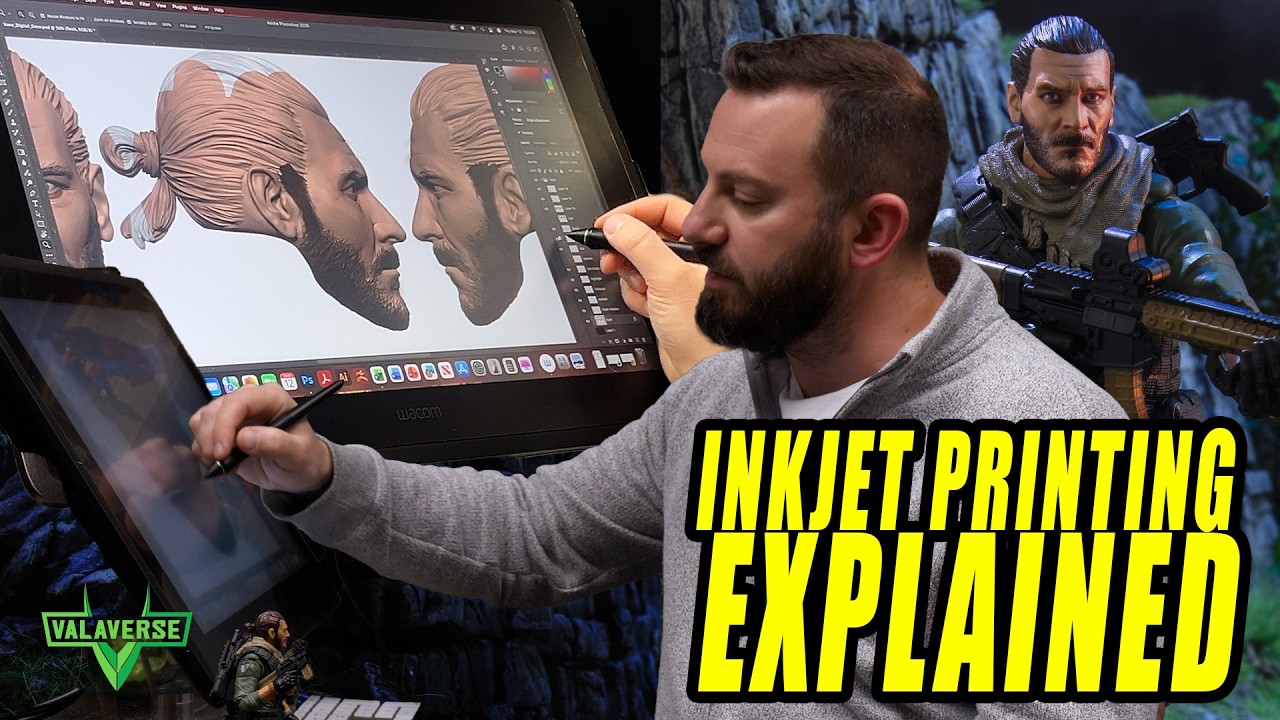
The action figure industry is currently undergoing a massive technological shift. While traditional manufacturing methods have served collectors for decades, a “peek behind the curtain” reveals that a digital revolution is taking place on the faces of our favorite heroes. This process, known as inkjet printing for toys, is rapidly becoming the gold standard for realism in the 1:12 scale and beyond.
A Masterclass from Valaverse
This deep dive into modern manufacturing is credited to the detailed insights shared by Bobby Vala in a recent Valaverse YouTube video (shown above). As a veteran of the industry who has worked on both major retail lines and independent projects, Bobby provides a rare look at the actual files and factory techniques required to bring a character to life. His explanation serves as a bridge between the technical side of toy production and the fans who collect these miniature works of art.
By walking through the development of his upcoming figure Vane, Bobby illustrates that high-quality digital deco is not just about the machinery; it is about the artistry of the layers. His transparency regarding the trial and error involved,from adjusting lip saturation to managing the “pixelation” common in early inkjet attempts, offers invaluable context for why some figures hit the mark while others miss.
What is Inkjet Printing for Toys?
For years, the industry relied on tampo printing, a mechanical process where a silicone pad stamps a solid mass of color onto a plastic part. While tampo is excellent for sharp, solid logos or simple eyes, it lacks depth.
Inkjet printing for toys functions much like the printer in your home office but adapted for three-dimensional plastic parts. It uses advanced print heads to spray microscopic droplets of paint in layers, allowing for:
- Gradients and Shading: Creating realistic skin tones and “5 o’clock shadows.”
- Depth of Color: Layering multiple hues to mimic human eyes.
- Photorealistic Accuracy: Capturing the likeness of actors from major franchises like the MCU or Star Wars.
The Evolution of the Digital Face
While import companies like Bandai (S.H. Figuarts) and Medicom (MAFEX) were early adopters, US-based companies have recently refined the process to reduce pixelation. Mattel’s WWE line was a pioneer in this space, utilizing “Real Scan” technology to bridge the gap between a digital sculpt and a digital deco application.
Today, many fans consider the G.I. Joe Classified Series by Hasbro to be the benchmark for this technology. Figures like Major Bludd and Crystal Ball showcase the potential of inkjet printing through complex facial scarring and subtle skin transitions. However, as with any emerging tech, there are learning curves, the infamous “Lt. Falcon” face stands as a reminder that the digital file must be perfectly calibrated to the physical sculpt.
Inside the Photoshop File: How Vane Comes to Life
At Valaverse, the creation of a figure like Vane (from the Black Ops line) involves a meticulous digital layering process. Since the figure is based on actor Zach McGowan, capturing his specific features requires more than a simple “spray and pray” approach.
The process begins with a base flesh-tone molded plastic, but the “life” of the figure is added through specific digital layers:
- Shadow Layers: Applied to recessed areas like brow lines, nostrils, and wrinkles to provide structural depth.
- The “Farle” (Highlight): A classic design term for the white highlight in the eye that gives the figure a “soul.”
- The Iris Gradient: Instead of a flat blue, the iris is built with speckles and darker outer rings to mimic a real human eye.
- The Beard & Stubble: Using textured Photoshop brushes to create individual hair follicles that fade naturally into the skin.
The Challenge of Multiple Passes
One of the biggest hurdles in inkjet printing for toys is the “one-plane” limitation. A standard print pass only covers the front of the face. For a character with a wrap-around beard like Vane, the factory must perform up to five passes:
- Frontal Pass: For the eyes, nose, and mouth.
- 3/4 Passes: Two passes to catch the transition from the cheek to the ear.
- Side Passes: To ensure the beard or stubble remains consistent across the jawline.
With each pass, costs go up.
Beyond the Face: Full Body Printing
While faces are the primary focus, companies are pushing inkjet printing into textiles. Hasbro’s Indiana Jones Adventure Series recently featured a figure (Kazim) with an entire suit decorated via inkjet. This allowed the designers to replicate a complex tweed fabric texture and pinstripes that would have been cost-prohibitive using dozens of individual tampo stamps.

The Future is Matte
One common critique of inkjet printing is its natural tendency to look glossy or “oily.” To combat this, Valaverse and other top-tier manufacturers have adopted a secondary process: applying a matte spray over the digital deco. This removes the plastic sheen and makes the inkjet applications, especially beards and skin, look incredibly lifelike.
As independent toy creators and major corporations continue to evolve, the move away from old technology such as pin-joints and flat tampo printing is inevitable. For fans of the hobby, this means the gap between a high-end statue and a retail action figure is smaller than ever before.
If you learned something from this video, drop a note in the comments section. Tell us what you learned, or what you thought was interesting about this whole inkjet printing process.

Leave a Reply